
March 12, 2026 · 4 min read
Why Fire Departments Are Becoming Social Service Gateways
By Megan McMillian
For most of their history, fire departments operated on a simple model: wait for the alarm, respond to the emergency, return to the station.
That model worked when fire was the dominant threat.
But today, the nature of community risk has changed—and so has the fire service.
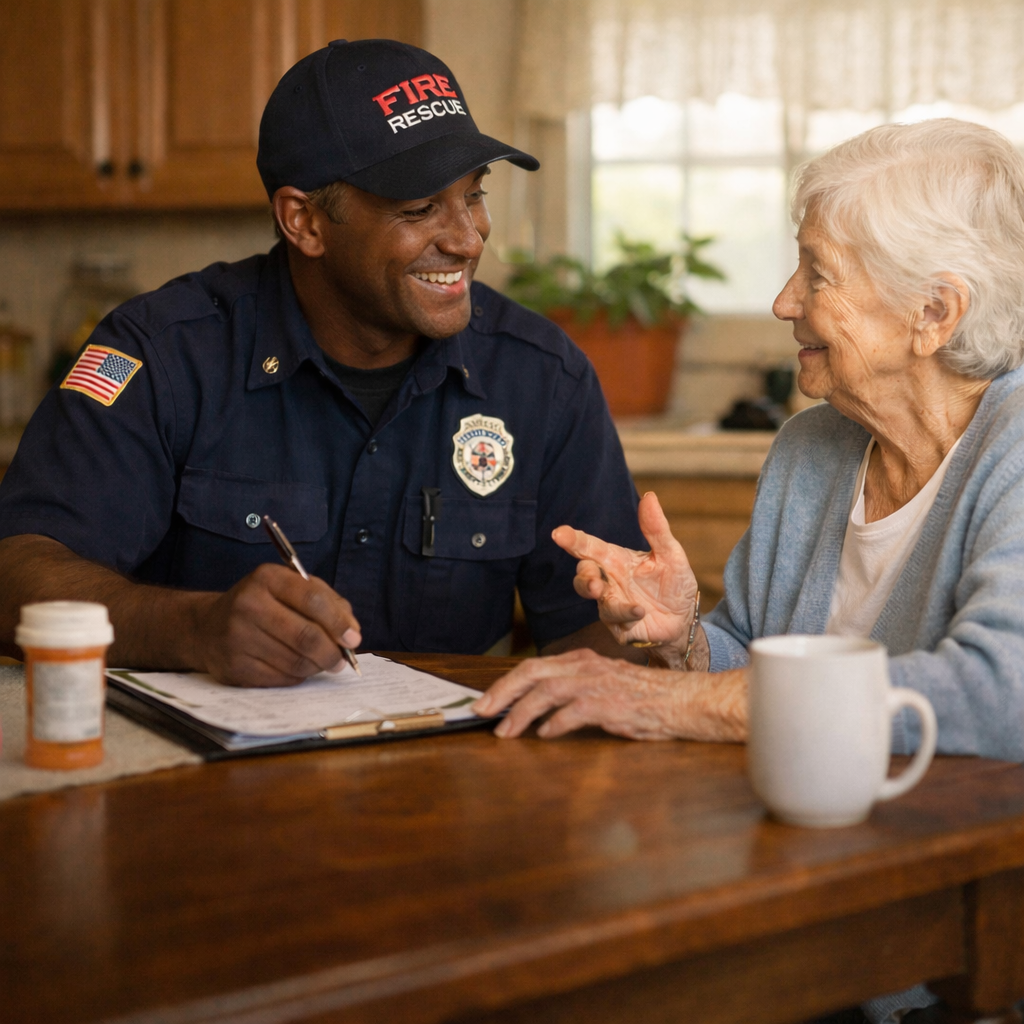
Across the country, departments are stepping into a new role: social service gateways. They are identifying vulnerable residents before a 911 call is ever made, connecting people to housing support, mental health services, and chronic disease management.
This shift isn’t theoretical. It’s operational—and it’s being powered by modern Community Risk Reduction (CRR) strategies and CRR software platforms like Atlas.
The Evolution of Community Risk Reduction (CRR)
Community Risk Reduction was once narrowly defined:
- Fire inspections
- Public education
- Smoke alarm installation
Today, CRR is a data-driven community health strategy.
Modern fire departments are using:
- Call history analysis
- Geographic information systems (GIS)
- Social determinants of health data
to answer a different question:
Not “Where did the last emergency happen?”
But “Where is the next one most likely—and how do we prevent it?”
This evolution requires more than programs. It requires systems.
Without CRR software, departments cannot:
- Track high-risk households
- Coordinate outreach efforts
- Measure outcomes across the community
Atlas provides the infrastructure to operationalize CRR at scale—turning data into proactive action.
Home Visits: The Front Line of Modern CRR
Proactive home visit programs sit at the center of this transformation.
Firefighters and community paramedics are now conducting:
- Wellness checks
- Fall risk assessments
- Environmental safety evaluations
- Social and medical needs identification
These visits often begin with something simple—like installing a smoke alarm—but quickly uncover deeper needs.
The challenge isn’t identifying risk. It’s managing it.
Atlas enables assessment workflows, ensuring every interaction leads to measurable outcomes.
Prevention: The Fire Service’s Most Powerful Tool
No institution has the same level of access and trust as the fire department.
That access creates a unique opportunity: prevention.
Modern CRR programs are expanding into:
- Fall prevention for seniors
- Medication management support
- Chronic disease monitoring
- Social needs identification
These interventions directly reduce:
- Repeat 911 calls
- Emergency department visits
- Hospital readmissions
But prevention only works when it’s consistent.
Community risk reduction software and CRR platforms like Atlas ensure prevention efforts are tracked, repeatable, and scalable—not dependent on memory or manual systems.
Partnerships: Building a Closed-Loop Care Network
Identifying needs is only half the equation. The other half is ensuring those needs are addressed.
This requires strong partnerships with:
- Hospitals and health systems
- Mental health providers
- Housing agencies
- Community-based organizations
- Area Agencies
Leading departments are moving beyond informal referrals to structured, trackable partnerships.
This is where most programs break down.
Without CRR software, agencies cannot:
- Track whether referrals are completed
- Monitor partner follow-through
- Measure impact across systems
Atlas creates a closed-loop referral system—ensuring every identified need leads to action, and every action is tracked to resolution.
Co-Response and Data Sharing: The Next Phase of CRR
Co-response models—pairing firefighters or paramedics with clinicians—are rapidly expanding.
At the same time, data-sharing agreements are transforming how agencies collaborate.
Examples include:
- Hospitals notifying fire departments of high-risk discharges
- CRR teams initiating follow-up visits within 48 hours
- Real-time coordination with behavioral health providers
But these models depend on infrastructure.
CRR software like Atlas enables:
- Secure data sharing
- Real-time case tracking
- Cross-agency coordination
- Outcome measurement
Without it, partnerships remain fragmented and difficult to scale.
Why CRR Software Is Now Essential
Fire departments are no longer just emergency responders—they are community health operators.
That shift introduces new operational complexity:
- Case management across multiple touchpoints
- Coordination across agencies
- Tracking social determinants of health
- Measuring long-term outcomes
Manual systems cannot support this level of work.
CRR software is what makes modern fire service strategy executable.
Atlas helps departments:
- Identify high-risk populations
- Manage outreach and home visits
- Track referrals and follow-ups
- Measure impact across the community
The Future: Fire Departments as Community Health Anchors
The departments that will lead in the next decade are those that embrace this evolution.
Becoming a community health anchor doesn’t replace emergency response—it reduces the demand for it, freeing up resources for the most citical of emergencies.
By investing in:
- Community risk reduction programs
- Community paramedicine
- Data-driven decision making
- CRR software infrastructure
departments can:
- Prevent emergencies before they occur
- Reduce repeat 911 utilization
- Improve outcomes for vulnerable populations
- Strengthen the entire local care network
Bottom Line
Fire departments are uniquely positioned to bridge the gap between emergency response and long-term care.
But doing so requires more than intent—it requires systems.
Atlas provides the CRR software and community risk reduction infrastructure needed to turn prevention into practice.
If your department is expanding into community risk reduction or struggling to manage outreach, referrals, and follow-up, the issue isn’t strategy—it’s execution.
Atlas helps fire departments operationalize CRR, coordinate care, and measure real impact.
Ready to build a more proactive, data-driven fire service?
Schedule a demo to see how Atlas supports modern CRR programs.